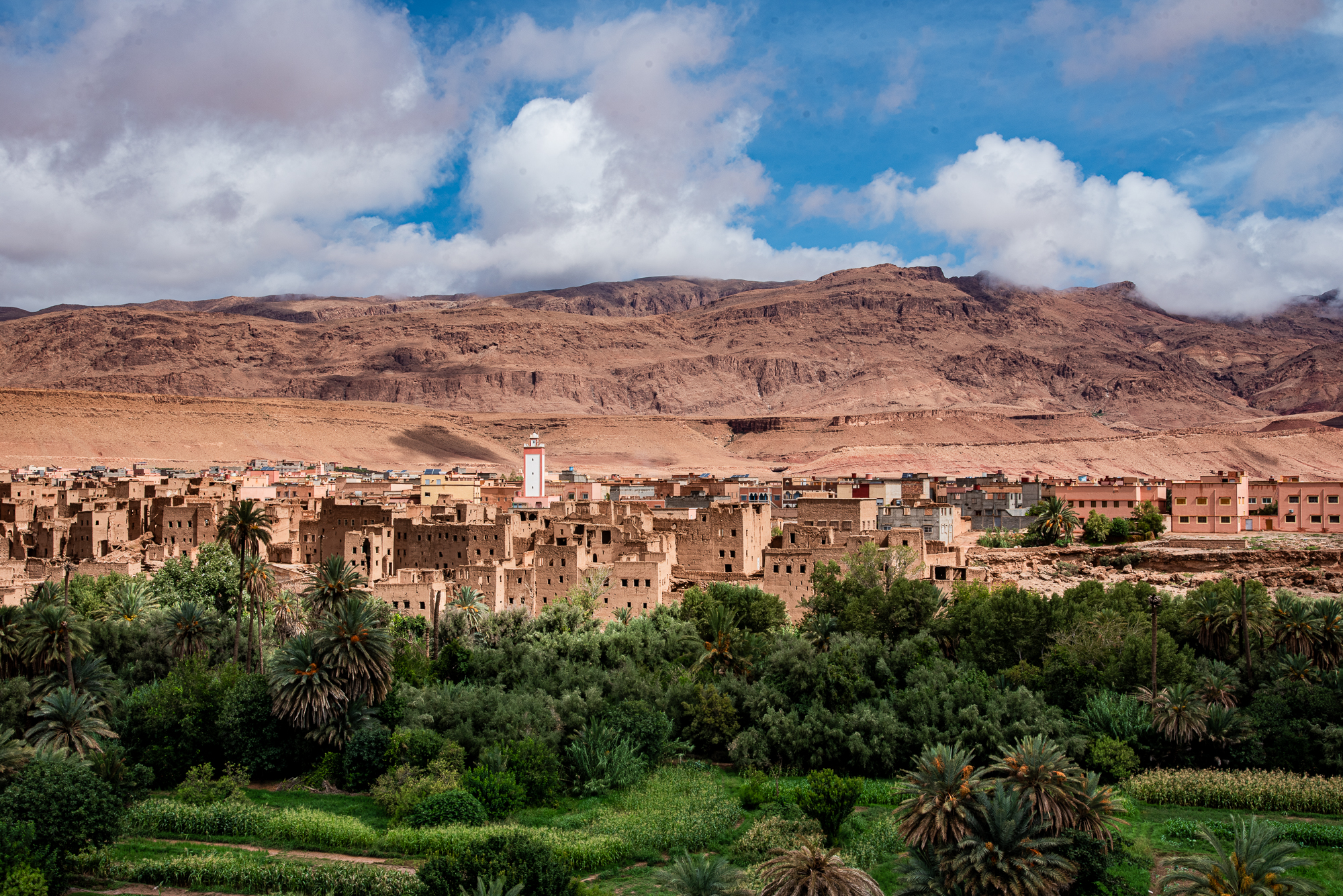

The centerpiece of visiting Morocco was seeing the Sahara. There are several guided options for visiting the desert from Marrakech, ranging from single-day trips to excursions of a week or more. We opted for a three-day tour which would take us to Erg Chebbi – the largest sand dunes in Morocco – and back, with several stops along the way.
However, Morocco experienced several days of heavy rainfall that weekend, causing historically severe flooding in the desert. The only routes to Erg Chebbi were flooded and impassable, so we never ended up making it all the way there. In spite of missing the dunes, we had an unbelievable overview of the Sahara, which should have been at least a couple days longer. The tour took us to valleys, mountains, gorges, oases, and more.

The Route
We opted for a tour that would travel a different route in each direction, to maximize sightseeing – unfortunately this didn’t pan out because of the weather.
Three days round-trip is a common tour length for visiting the dunes at Erg Chebbi; we started and ended in Marrakech but there are also routes that go from Marrakech to Fes via the Sahara (and vice versa) which would be a great way to see more of the country. The scheduled tour followed Highway N9 over Tizi n’Tichka pass to Ourzazate, N10 to the Dades Valley and Errachidia, and N13/N17 until Merzouga (where Erg Chebbi is located). The return traveled N21 and N9 back to Marrakech via Ourzazate.
That was the plan, anyway.

We ended up turning around in the town of Aoufous, just south of Errachidia, due to a bridge that was completely impassable from the floods. Most other roads in the region were closed as well and the closures forced us to return via the same route we’d taken into the desert.

Day 1: Marrakech to the Dades Valley
Our guide, Mohamed Nogot, picked the three of us up a few minutes’ walk from our riad in Marrakech in the morning, and we left the city in a comfortably roomy van. Although I didn’t know this when booking the tour, we were incredibly fortunate to experience the Sahara with Mohamed, who was raised nomadically in the desert until the age of six and whose parents still live in Merzouga.
Shortly after leaving Marrakech, we started driving steadily uphill into the Atlas mountains. The highest point on the highway was Tizi n’Tichka pass, one of the highest roads in Morocco, and we stopped to admire the breathtaking views.

As we made our way down the eastern side of the Atlas into the desert, the scenery transformed into a palette of reds and oranges. We drove through this portion of southeastern Morocco to Aït Ben Haddou, a thousand-year-old ksar (fortified town) where people still live. The town was a crucial stop along a former trade route, and is now frequently used as a backdrop in movie productions including Gladiator and Game of Thrones. The tourism industry in Aït Ben Haddou leans heavily into this comparatively recent history.
Sticking with the cinematic theme, our next stop was in the city of Ouarzazate, home to Atlas Studios. This production site has played host to pretty much every American blockbuster set in the desert, and these sets are mostly preserved – the list includes Cleopatra, Lawrence of Arabia, The Mummy, and more. We drove by the studio but elected to not visit.

We then continued through the desert to the Dades Valley, passing through the town of Kalaat M’Gouna on the way. This town is famous for its rose products, but we were a few months late for rose harvesting season, so I was mostly struck by the hot pink taxis.
Then it started to rain.
In the town of Boumalne Dades, we turned onto a smaller road (R704) and followed the west side of the Dades valley back up into the mountains to Riad Gabsi Dades, where we were staying that night. The valley follows a riverbed which is normally a trickle at most in September, but under these circumstances was a full-blown river.
This riad was unforgettable, and we had an enormous room with a balcony overlooking between the three of us. Dinner was prix fixe and several courses long. It was my favorite lodging of the trip, in an area where I would have loved to spend more time. There are trails all over the valley, including around the “Monkey Paws” rock formation where I ran the next morning.

Day 2: The Dades Valley to Merzouga…Almost
That night, there was a torrential downpour the entire time I was asleep. Though it had been sunny for most of the day, this was the second straight night that the Sahara received 4-5 inches of rain. Mohamed said nothing like that had ever happened before, especially not during the dry season. The riverbed was rushing the next morning and there were ankle-deep puddles and mud everywhere. It was astonishing to see how the landscape had transformed in 12 hours.
After breakfast, we got back into the van and continued further into the desert. Along the way, we stopped at the Todgha Gorge, where a narrow river meanders between cliff faces. Most of the drive from the Dades Valley to Aoufous consisted of straight roads through flat, arid landscapes with rolling mountain ranges on the horizon. Occasionally, the highway would pass above a gorge, and we could look down into valleys brimming with palm trees.

Eventually, we reached Aoufous and ran into a standstill traffic jam, primarily other tour groups hoping to make it to Merzouga. We waited for a bit, but Mohamed confirmed that the bridge was entirely flooded out and we would not make it to the dunes that night. We turned around and drove to Errachidia, the capital of the Drâa-Tafilalet region, where we stayed at Hotel Tinit. We did our best to figure out changing plans to spend more time in the desert and make it to Erg Chebbi, but there was no guarantee of when the road would be passable again, so we decided to head back to Marrakech the next morning.
Day 3: Errachidia to Marrakech
After a run through Errachidia and breakfast, we got back into the van for the long drive home. We stopped a couple times for food and breaks, but mostly sat in the car and admired the Sahara scenery for one final time. Although it was undeniably beautiful, I felt a small amount of disappointment for not making it to the iconic dunes of Erg Chebbi. After about 10 hours in the car, Mohamed brought us to our lodging back in Marrakech, and we parted ways.
If ever there was evidence that the journey is more important than the destination, this is it. We didn’t make it to our top priority in the Sahara, but saw astonishing desert landscapes every step of the way. Hopefully when I next visit Morocco, I’ll be able to see the dunes – if nothing else, this provides a prime reason to go back.
