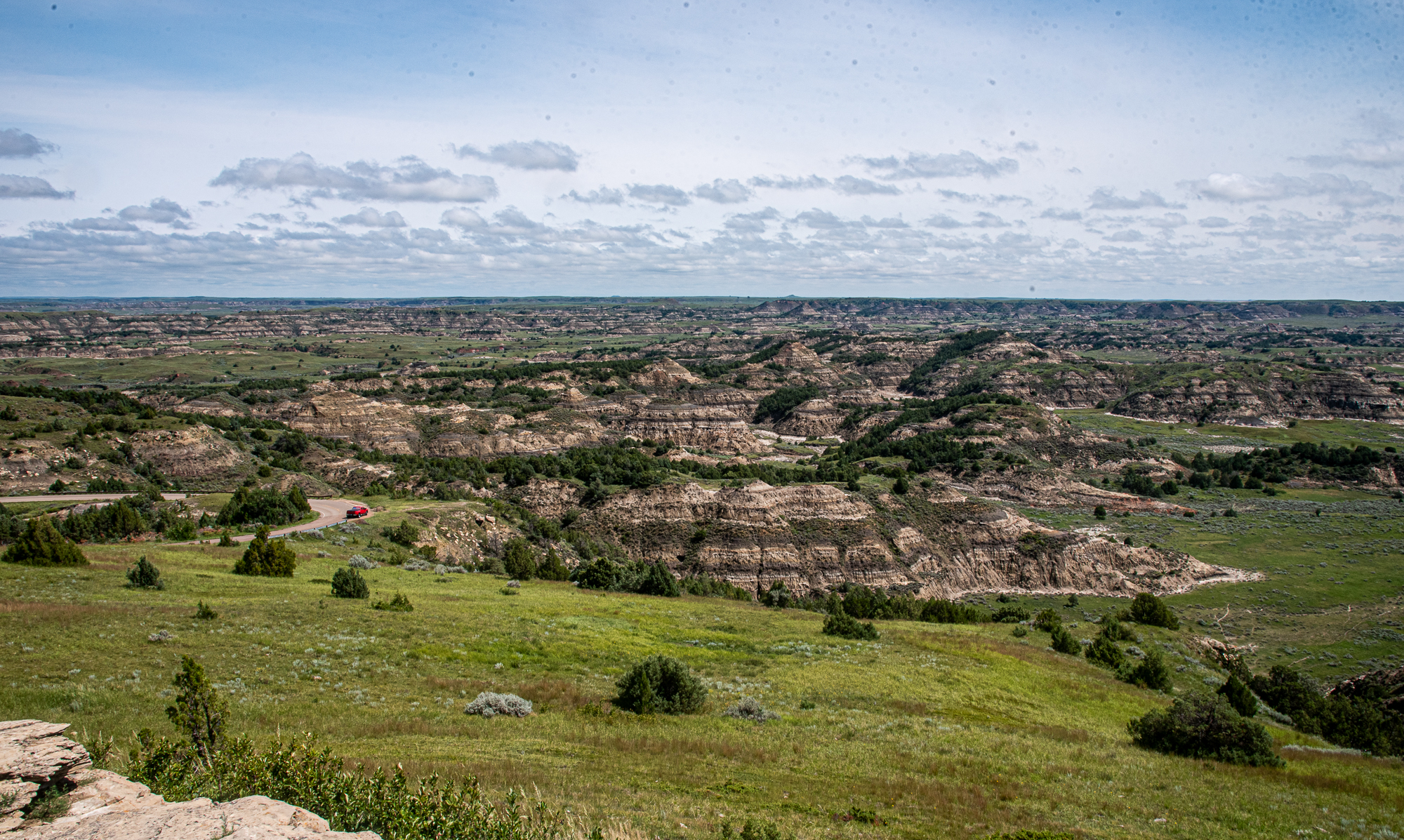

Driving along the highways of western North Dakota, the scenery was mostly what I expected: gently rolling grasslands, straight-line roads, herds of cattle, and the occasional town with triple-digit population numbers on the “Welcome” sign.
And then, a few miles after turning from Route 85 onto I-94 West, there’s a sign that reads “Theodore Roosevelt National Park Next 13 Miles.” The park’s South Unit borders the interstate, and after another mile of road, the plains north of our car seemed to crack open to reveal layered canyons and buttes stretched out to the horizon.
This rugged landscape, set amid a sea of ranchland, offers a deep look into the Great Plains ecosystem – flowering meadows, meandering rivers, and ample wildlife. TRNP is spectacular, but it remains highly remote for most non-North Dakotans. That remoteness, combined with a total lack of services within the park, provides a wonderful feeling of isolation.

Getting There
TRNP is not particularly challenging to access – it’s just far away. The South Unit entrance is just off I-94, in the far west of North Dakota; the North Unit is 50 miles north on Highway 85; and Elkhorn Ranch sits in between, which is a bit trickier to get to and requires driving on gravel roads. It’s worth mentioning that the North Unit is in the Central Time Zone, while the rest of the park is on Mountain Time.
We drove up from Custer State Park in South Dakota’s Black Hills, a fairly monotonous five-hour drive across the plains. It was the week of the Sturgis Motorcycle Rally, but north of Deadwood, SD, the constant roar of motorcycles quickly died out. Traveling north on 85, services and towns become few and far between at that point too.

The South Unit visitor center is within the small town of Medora, ND, found just off Exit 27 on I-94. There is a separate visitor center located five miles eastward on the interstate, at the Painted Canyon Overlook – there’s a viewpoint and short trail there, but it does not connect by road with the rest of the South Unit.
North Dakota was the final stop on a road trip, and we flew out of Bismarck afterward, about a two-hour drive due east on I-94. There are two other airports in the area with regular flight service: Dickinson, with daily flights to Denver; and Williston, with flights to Denver, Las Vegas, and Minneapolis. Williston is only an hour drive from the North Unit.
Within the Park
Past the visitor centers, there are no services in TRNP, and the two units have one road apiece. In the South Unit, that road is a 36-mile loop (partly under construction when we visited, turning it into a 22-mile out-and-back). The North’s is 14 miles one-way.
Each unit has one campsite. In the South Unit, we stayed at the Cottonwood Campground – half of the spots are reserved ($20/night) and the other half are first-come, first-serve. There are bathrooms and potable water available, but no showers. When we visited in early August, there were still two campsites available around 8 p.m., but I imagine they often fill up earlier.

We lucked out with our spot, #61. It was the furthest campsite from the road, meaning that we could look out on the Little Missouri River slicing through the prairie without any other people in sight. It was stunningly peaceful and quiet down by the water as the sun was setting. Then, around 3 a.m., the wind began whipping and rain started to fall. Our tent held just fine, but got quite a bit of dirt in it from the fierce wind blowing through the plains.
If that’s not appealing, there are plenty of lodging and food options in Medora – not to mention the North Dakota Cowboy Hall of Fame.

What To Do
I wanted to go to North Dakota for the same reason many people do: I hadn’t been before, and it was my 49th state (still waiting on Alaska). The state is wonderfully self-aware of this fact – the park gift shop sold magnets with the North Dakota state border outlining the phrase “I saved the best for last.” Although I didn’t see much of the state, I was blown away by how much TRNP had to offer.
- Spotting wildlife: We saw bison, extensive prairie dog towns, a coyote, various bird species, and a majestic herd of wild horses galloping across the badlands. The prairie dogs are everywhere, but I never got tired of seeing them jump out of their tunnels and screech.
- Hiking: There are various trails that traverse both park units, most notably the 150-mile Maah Daah Hey trail which meanders through both units and the Elkhorn Ranch. We hiked portions of the Ekblom and Big Plateau Trails, starting from the Peaceful Valley Trailhead just off the scenic drive. An important note: when we did this hike in early August after a few days of heavy rain, it required fording the Little Missouri River, which was about knee-high and incredibly muddy underfoot. Other accounts from the late summer and fall indicate that this is rarely the case (I’d read about stepping stones which were nowhere to be seen). As such, when tackling the Maah Daah Hey or any other hike which requires crossing the river, it’s important to be prepared and anticipate getting a bit muddy.
- Scenic Drives: Along the roads cutting through the prairies and badlands, there are various short (less than a half-mile) hikes to scenic vistas. It’s worth stopping at each one.

Because of Theodore Roosevelt National Park’s location – tucked in a corner of North Dakota, amid the remote northern Great Plains – it’s hard to end up there by accident. But the isolation is part of the appeal, and making the long trip is unquestionably worth it. No need to save it for last.